
Options pricing explained
What you actually pay for — intrinsic vs extrinsic value, and the forces that move an option's premium.
Intrinsic value
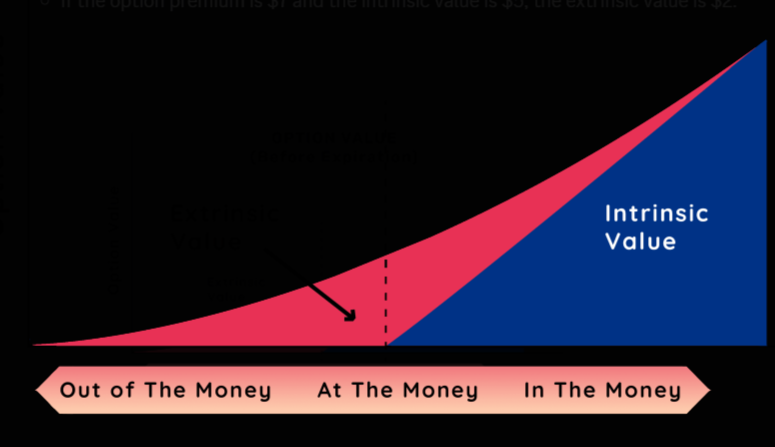
An option's price — its premium — comes from two parts. The first is intrinsic value: what the option is worth if you exercised it right now.
Call intrinsic value = max(0, current price − strike). Put intrinsic value = max(0, strike − current price).
Example: a stock at $55 with a $50-strike call has $5 of intrinsic value ($55 − $50).
Extrinsic (time) value
The second part is extrinsic value, also called time value — the extra you pay for the time left and the market conditions.
Extrinsic value = premium − intrinsic value.
Example: if the premium is $7 and the intrinsic value is $5, the extrinsic value is $2.
What moves an option's price
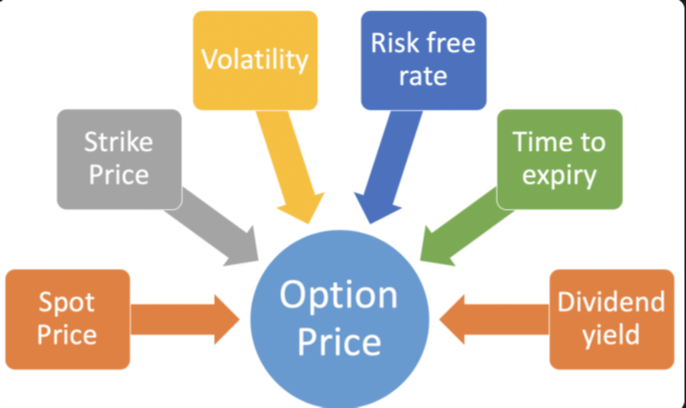
Option prices come out of pricing models like Black-Scholes. Several inputs push the premium up or down at the same time.
The key factors
Here's how each one works:
- Time to expiration — more time means more extrinsic value; as expiry nears, that value bleeds away (theta decay). A 3-month call might cost $10 where a 1-week call on the same strike costs $2.
- Volatility — implied volatility (IV) is the market's expectation of future swings; higher IV means richer premiums. A biotech before an FDA decision has far pricier options than a stable utility.
- Underlying price — the closer the asset trades to the strike, the more extrinsic value. A $50-strike call is worth more with the stock at $49 than at $40.
- Interest rates (rho) — higher rates tend to lift call values and weigh on puts.
- Dividends — stocks paying big dividends often have cheaper calls, since the price usually drops after the payout.
Putting it together
Stock ABC trades at $60. You're looking at a $55-strike call, expiring in a month, priced at $8.
Intrinsic value = $60 − $55 = $5.
Extrinsic value = $8 − $5 = $3.
That $3 is what you're paying for the time left and the chance the stock climbs further.
Final thoughts
Knowing what makes up a premium — and what moves it — is what separates guessing from strategy. Time decay, volatility and the rest all pull on the price at once.
Next: the Greeks, which measure exactly how sensitive an option is to each of these factors.
Educational content — not financial advice.